
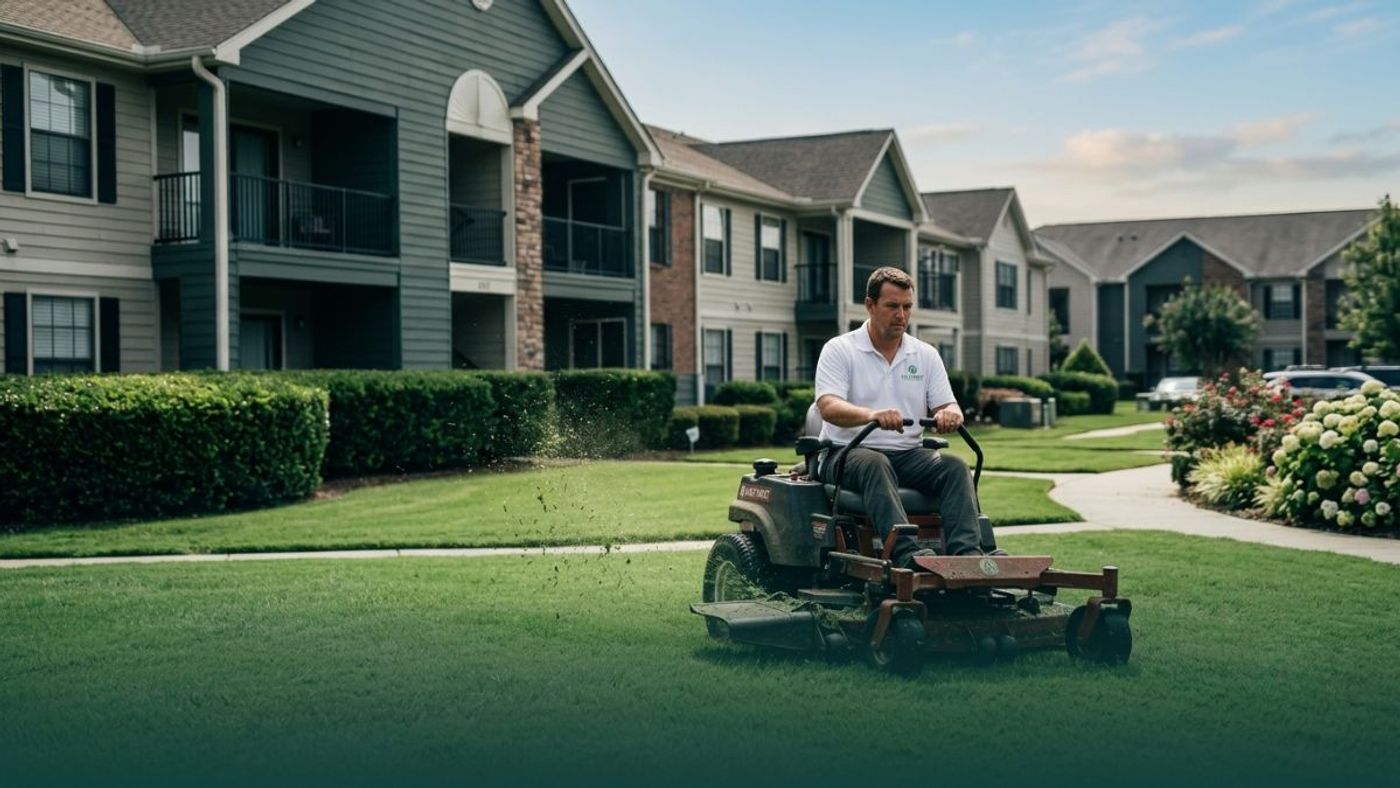
Most commercial properties need mowing every five to ten days through spring and summer, then that stretches out to every three to four weeks once growth slows down in autumn and winter. That single swing in frequency is the difference between a lawn that looks sharp year-round and one that only looks sharp for half of it, and it's the first thing that goes wrong when landscaping services are scheduled on a fixed cadence instead of one that moves with the season.
Turf isn't the only thing on the calendar. Shrub and tree pruning, deep-root fertilisation and pest monitoring usually run on a monthly cycle because they don't grow at the same pace as grass does. Then there are the seasonal jobs, typically four a year, tied to the calendar rather than to growth rate: spring bed preparation and pre-emergent weed control, a summer irrigation audit, fall leaf removal and overseeding, and winter dormancy prep or storm response. A single contract usually runs all three tiers in parallel, weekly mowing alongside monthly pruning alongside seasonal clean-ups, rather than treating grounds care as one flat service.
What Decides A Commercial Landscaping Services Schedule
Climate is the biggest factor. A warm-season lawn in the Southeast can need cutting every five to seven days at the height of summer, while a property in a milder or drier region might stretch that to every ten days without anyone noticing the difference on the ground. Property size and foot traffic matter too. A common area residents walk through daily needs a tighter schedule than a back lot nobody sees, and a property with detailed beds, edging and hardscaping leans toward weekly visits just to keep everything looking finished.
The mistake most property managers make is locking in one frequency for the whole year and never revisiting it. A schedule set in April is usually wrong by August, and a schedule that ignores the dormant-season slowdown means paying for visits the lawn simply doesn't need. A tiered schedule, agreed with the provider at the start of the contract and built to shift automatically with the season, avoids both problems without anyone having to remember to call and change it.
Keeping Grounds On The Same Schedule As Everything Else
For a portfolio already running work orders, inspections and turnovers through one crew, grounds scheduling is simplest when it sits on the same calendar as everything else. A crew that's already on site for a unit turn or an exterior inspection can flag an overdue mow or a pruning job that's fallen behind, instead of waiting for a separate landscaper's next visit to notice it. It also means one point of contact is accountable for the whole schedule, not two vendors quietly assuming the other one is on top of it.
Get the frequency right for the season and the property, and grounds care mostly stays ahead of problems rather than catching up on them every few months. Get it wrong, and it's usually not obvious until the lawn is already behind.