
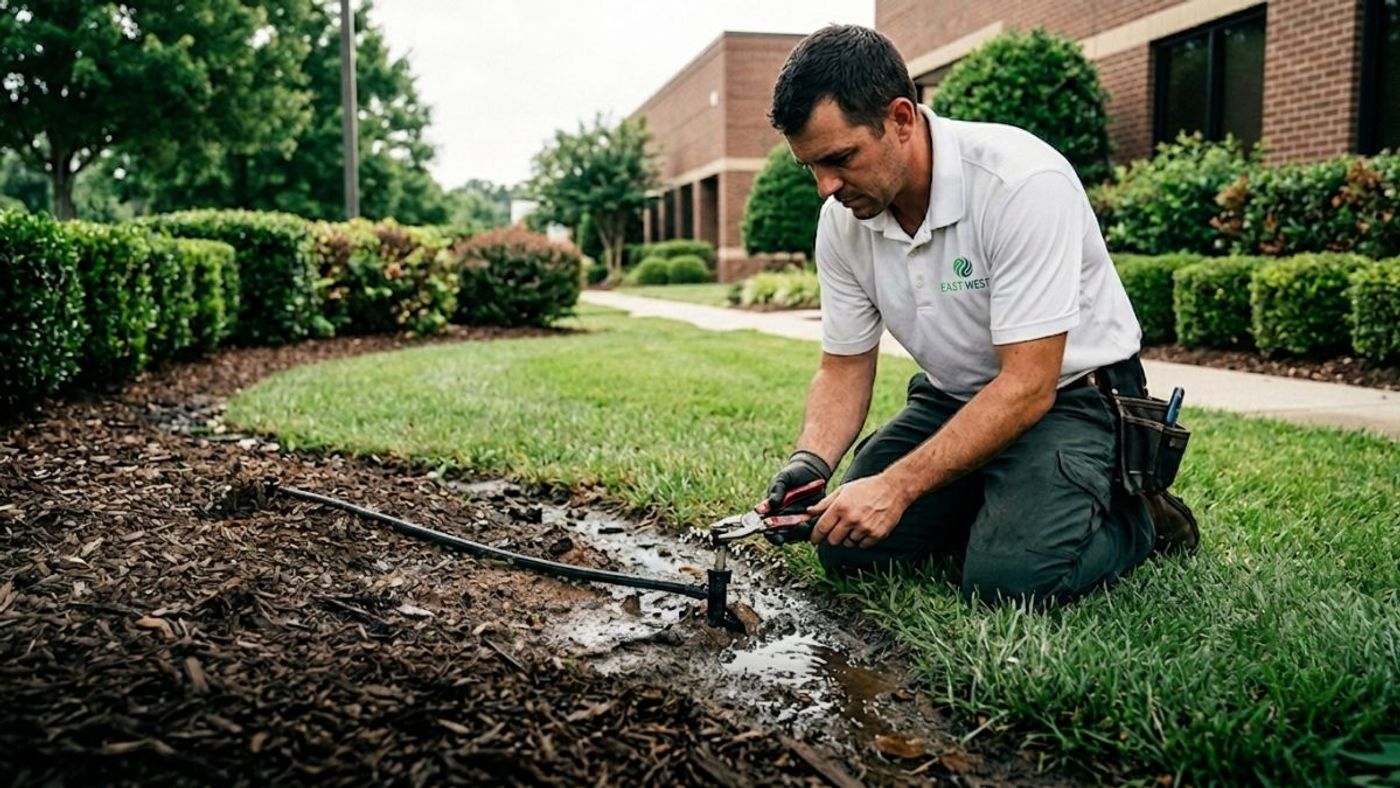
A cracked irrigation line can soak the ground round a building's foundation for weeks before anyone notices, and that's exactly the sort of thing landscape maintenance services are meant to catch early. For property managers comparing landscaping services near me, the real question isn't who mows the fastest lap round the car park. It's who actually checks what's happening underneath the turf.
Most commercial contracts bundle mowing, edging and blowing together as the baseline, then add irrigation inspection and repair, pruning, fertilisation, aeration and weed control on top. Seasonal jobs get folded in too: spring bed preparation, fall leaf removal, and winter storm response. Detention ponds, drainage channels and hardscaping often get left off the list entirely, even though a blocked drain or an eroding pond bank causes some of the more expensive damage a site can pick up. A proper provider checks all of it on a rolling schedule, not just the bits that show from the road.
What Should Be In A Landscape Maintenance Services Contract
The gap between what a property manager assumes is covered and what's actually written into the contract is where most disagreements start. Irrigation is the clearest example. A system that isn't checked zone by zone for head alignment, run times and soggy patches can waste water and money for months before it shows up as a problem on the bill. Pruning works the same way. Left too long, overgrown trees and shrubs shade out the grass underneath, block sightlines round entrances and signage, and create tripping hazards along walkways that someone eventually has to answer for.
Documentation matters just as much as the work itself. Timestamped photos from before, during and after each visit, along with notes on any chemical applications and site conditions on the day, give a property manager something to check against rather than taking a crew's word for it. Without that record, it's hard to hold anyone accountable when a task quietly stops happening, and even harder to prove to an owner or board that the money is being spent properly.
Where Grounds Care Fits Into The Wider Property Picture
Landscaping rarely sits on its own in practice. It overlaps constantly with occupied-unit repairs, exterior inspections and the general condition of a property that a maintenance crew is already tracking week to week. Running grounds work through the same crew that handles inspections, securing and turnovers means an overdue prune or a failing sprinkler head gets flagged the moment someone's on site for something else, rather than waiting for a separate landscaper's next scheduled visit to spot it.
A property that's mowed on schedule but never checked underneath still ends up with the same drainage and irrigation problems as one that's neglected altogether, just later and more expensive to fix. A contract worth signing catches both, and the easiest way to know it's actually happening is a record you can look at rather than a lawn you have to take on trust.