
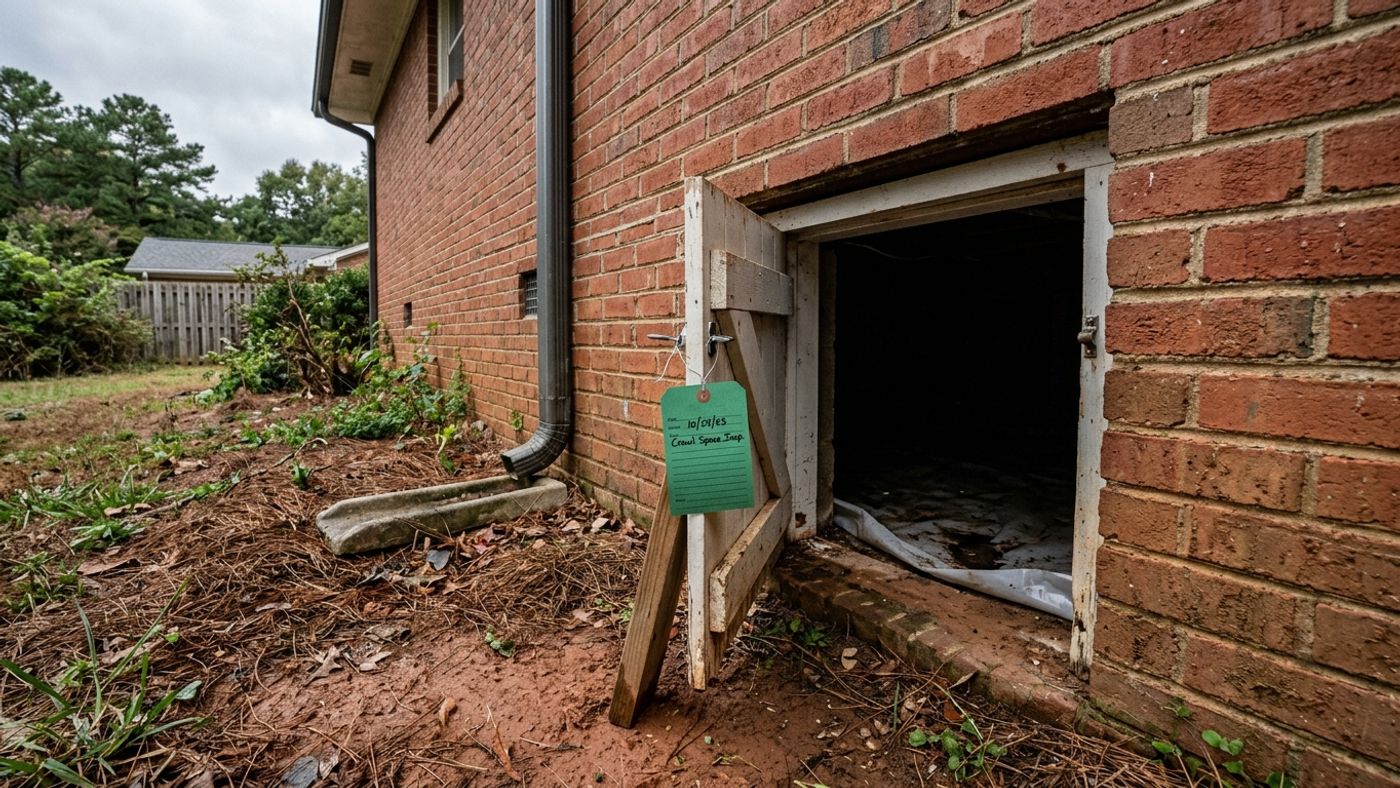
Roughly 250,000 new homes are built over crawl spaces in the United States every year, and most of them sit in a band running from northern Florida up through the Carolinas and into the Midwest. Across North Carolina, from Raleigh and Durham to Greensboro, Charlotte and Fayetteville, the crawl space is one of the most common foundation types on the market. For anyone handling vacant property maintenance in North Carolina, that makes the space under the floor one of the first places to check and one of the easiest to forget.
For decades, crawl spaces were built with wall vents on the theory that outside air would dry them out. Field research carried out in North Carolina in the early 2000s found the opposite. In the humid Southeast, warm, moist summer air drawn through the vents condenses on cooler framing and ductwork, adding moisture rather than removing it. Homes in the same study with properly closed crawl spaces, sealed from outside air and lined with a vapor barrier, stayed noticeably drier and used less energy for heating and cooling. That work went on to shape the North Carolina building code, which now makes closed crawl spaces easier to install.
Crawl Space Maintenance for Vacant Homes in North Carolina
A vacant home removes the early warning system that most crawl space problems rely on. Occupants notice a musty smell, soft spots in the floor or a spike in the power bill. In an empty house, standing water after heavy rain, a torn vapor barrier, insulation sagging off the joists or a disconnected dryer vent can go unnoticed for months. By the time someone opens the access door, a moisture problem may have turned into wood rot, mold on the framing or pest activity.
A routine crawl space check on a vacant property should cover a few basics. Look for standing water or wet soil, especially near the access door and along the perimeter walls. Confirm that the vapor barrier is intact and covering the ground, since research on closed crawl spaces points to a liner of at least 6 mil polyethylene as the minimum needed to stop ground moisture. Check that insulation is still attached, ductwork is connected and sealed, and the access door closes properly. Gutters, downspouts and grading outside matter just as much, because water that pools against the foundation finds its way underneath.
Utilities, Dehumidifiers and Closed Crawl Spaces
Closed crawl spaces don't take care of themselves. Many depend on a dehumidifier, a sump pump or a small supply of conditioned air from the HVAC system to stay dry. When utilities on a vacant home are shut off or set to minimum, those systems stop working, and a crawl space designed to stay dry can start collecting moisture quickly. Knowing which type of crawl space each property has, and what equipment keeps it dry, should be part of the initial inspection on every vacant or REO home in North Carolina.
Crawl spaces are out of sight, but they carry a big share of the risk on a vacant property. East West Maintenance coordinates property maintenance and field services for vacant and REO homes across North Carolina, South Carolina and Florida, and the space under the floor is always part of the job.