
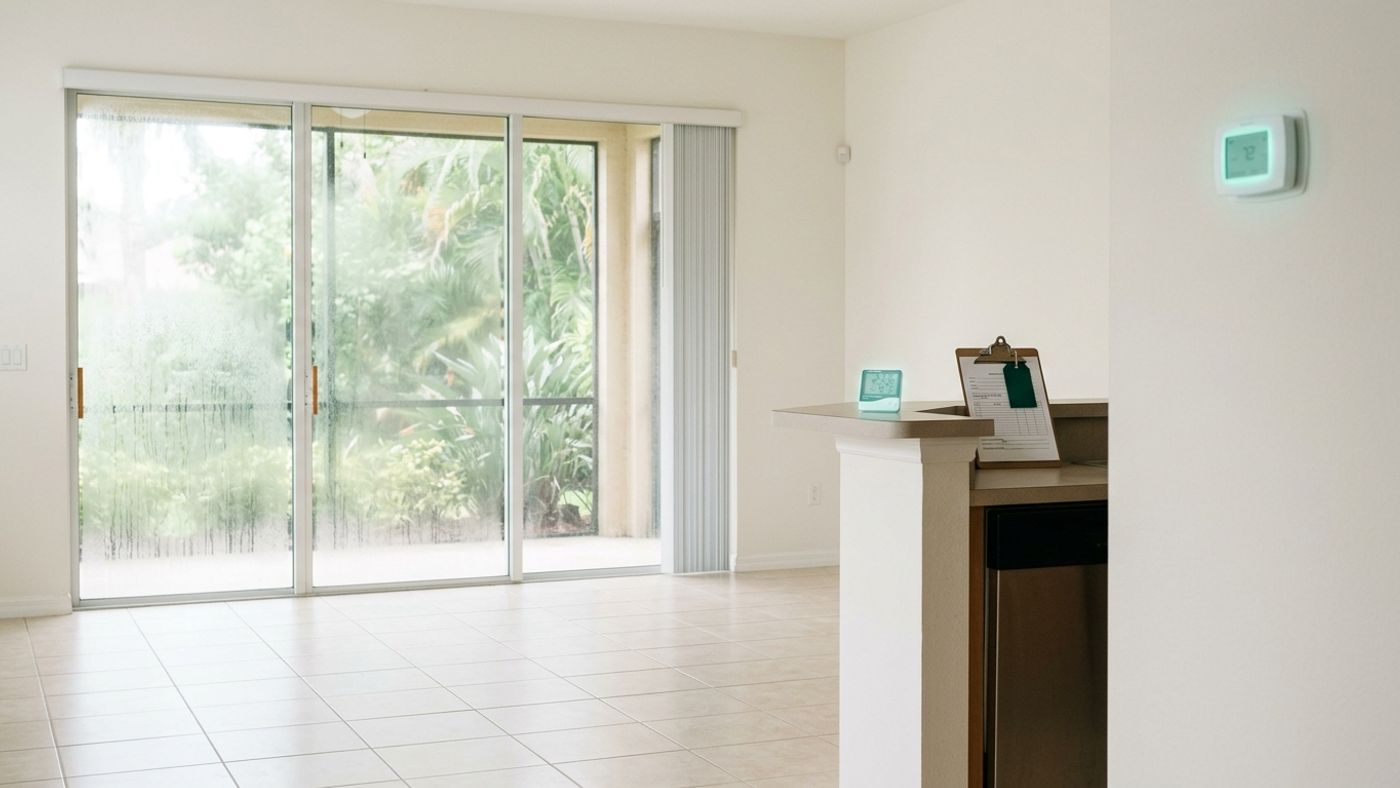
Federal indoor air guidance recommends keeping indoor relative humidity below 60 percent, and ideally between 30 and 50 percent, to limit mold growth. In Florida, where outdoor air stays humid for much of the year, holding a home inside that range takes a working air conditioner and a plan. For anyone handling vacant property maintenance in Florida, from Jacksonville and Tampa to Orlando, Lakeland and Fort Myers, humidity control is one of the most important jobs on an empty house.
An occupied home manages humidity almost by accident. People run the AC, open doors, take showers with the exhaust fan on and notice when something smells off. A vacant home has none of that. If the air conditioner is switched off to save on utilities, or the thermostat is set too high, moisture builds up inside the walls, cabinets, carpet and drywall. Mold can take hold on surfaces long before anyone walks through, and a home that looked clean at the last visit can smell musty a few weeks later.
Humidity Control for Vacant Homes in Florida
The basic rule from mold prevention guidance is simple: moisture control is mold control. When water from a leak or spill is dried within 24 to 48 hours, mold usually won't grow. On a vacant property, the challenge is that nobody is there to see the leak in the first place. That's why the most important humidity tasks are about keeping systems running and catching water early.
On a Florida vacant home, that starts with confirming the air conditioner is on and set to a sensible level for an empty house, not switched off entirely. AC drip pans need to be clean and condensate drain lines clear and flowing, since a blocked line can overflow into ceilings or closets with nobody home to notice. A small digital humidity meter left in the house gives inspectors a quick reading at every visit, and condensation on windows or vents is a sign that humidity is running too high. Outside, the ground should slope away from the foundation so rainwater doesn't collect against the walls.
What to Check on Every Visit to a Vacant Florida Property
Regular visits are where humidity problems get caught. Each walk through should include a check of the thermostat setting and AC operation, a humidity reading, and a look and sniff test in closets, under sinks, behind toilets and around windows and sliding doors. Ceiling stains, peeling paint, warped baseboards and dark spots on grout or drywall all point to moisture that needs attention. Refrigerators and freezers that were left closed after the power was cut, and dishwashers or washing machines with standing water, are also common sources of odor and mold in empty homes. Photos and readings from each visit give owners and asset managers a clear record of the home's condition over time.
Florida's climate makes humidity a constant pressure on any building, and an empty one has no defense unless someone keeps the systems running. East West Maintenance coordinates property maintenance and field services for vacant and REO homes across Florida, North Carolina and South Carolina, with humidity checks built into every visit.